 |
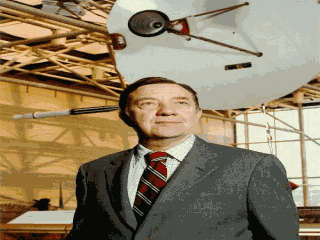
James A.Van Allen was born in Mt.Pleasant, Iowa. Following his early
education in the public schools there, he attended Iowa Wesleyan College and
received a B.S. degree in physics in 1935. His graduate study was at the
University of Iowa, with an M.S. degree in 1936 and a Ph.D. degree in
nuclear physics in 1939. Subsequent professional experience included
research at the Carnegie Institution of Washington and the Applied Physics
Laboratory of Johns Hopkins University as well as World War II service as a
naval officer in the Pacific Fleet. In 1951, he returned to the University
of Iowa as a professor of physics and head of the Department of Physics
(after 1959 the Department of Physics and Astronomy). He has been a pioneer
in space exploration including discovery of the radiation belts of the Earth
in 1958 and the first missions to the planets Venus, Mars, Jupiter, and
Saturn. He has authored 246 research papers and two books on planetary
magnetospheres, cosmic rays, solar energetic particles, and solar X-rays and
has directed 34 Ph.D. dissertations and 45 M.S. theses in these fields. He
received a National Medal of Science from President Reagan in 1987, the gold
Medal of the (U.K.) Royal Astronomical Society in 1978; the Crafoord Prize
of the Royal Swedish Academy of Science from King Carl XVI Gustaf in
Stockholm in 1989; the Nansen Medal and Prize from the Norwegian Academy of
Science and Letters in Oslo in 1990; and the 1991 Vannevar Bush Award of the
National Science Board. He and his wife, the former Abigail Fithian Halsey,
have three daughters and two sons. |


