• Bibliotheca Alexandrina
    A Digital Library of the Middle East
    Alexandria, Egypt
    Monday  16 January 2006
  • .
  • ocr1

  • Dr. Ismail Serageldin
    Director, Bibliotheca Alexandrina
    16 January 2006
    "The  Bibliotheca Alexandrina was born digital.....
    a project ambitious in its scope but feasible...with new and emerging technologies...


  • Dr. Sherif El  Iskandarany
    Deputy Director, Egyptian Academy of Scientific Researc
    "The statistics show that we have achieved a goal....scientific and technical cooperation between Egypt and the United States."
  • Dr. Stephen Griffin
    Program Director, Computer and Information Science and Engineering
    United States National Science Foundation
    Unintended consequences..cultural heritage...scientific applications
  • Dr. Joyce Ray
    Institute of Museum and Library Services
    "We will make awards..... digital asset management is a major emphasis...
    is a library a building....or access to  information?
    this is a thrilling moment"
  • H.E. Dr. Ahmed Darwish
    Minister, Ministry of State for Administrative Development
    Egypt
    16 January 20
    "The  borderline between digital and library....the library will come to you...
    the Ebay way of building credibility, the peer review way of building credibility...
    all this will change..  IEEE will change, since posting brings comments
    [RFC]
    How are we going to link articles together?
    With limited resources, what do we save?
    Query in any language.....and search across all languages...
    The issue of language translation is critical

    The Bibliotheca Alexandrina is a [ candle | lantern | light | beacon ]

    No one can do this on their own."

  • Dr. Amr Badawy
    Senior Advisor to the Minister
    Ministry of Communications and Information Technology
    Egypt
    16 January 2006
    "Since January 2, over 4 million citizens have  access at .20 / hour,
    an initiative supported by Telecom Egypt. 
    Free access to the Internet for all Egyptian citizens. 
    Target: 7 million in 1.5 mm households.....
    our initiative is to provide Internet access for all those who are illiterate...

    Obtain PC's for every home
    At leat 256kb/sec to each home--reduce prices 50% for ADSL...150 pounds/month
    300 Wifi Hotspots.....CDMA wireless...40 km radius...250Kb  [2.3Mb]
    National Network for Universities and  Research
    ENERGI.....Internet 2...
    FLAG SEA..Alitar...Falcon...unique position to act as regional hub
    now 4.3 Gbit/sec....  6 gateways operated by TE


  • John Gage
    Chief Researcher
    Sun Microsystems

  • Grand Challenges for the Global Digital Library
    Grand Challenges for the Digital Library of the Middle East

    Be of use in transforming people's lives
    Allow the broadest understanding and sharing of human culture
    Apply the most advanced scientific and technical capabilities to broadening  access by all to knowledge
    Create political and institutional leadership to build the environment that makes universal access possible
    Build the tools for collaboration 
    "No one can do this on their own"--Darwish

  • Grand Challenges for Computing

    Simulation and interaction with life
    Merger of data structures with computational mechanisms of the living cell
    Secure, ubiquituous and distributed systems
    Languages of identity and trust
    Robust, self-healing, and dynamically self-aware systems

    Collaboration, creation, innovation
    based on open standards, open exchange, and open innovation
  • A change is occuring now....a synthesis of tools made possible by powerful computing, massive storage, extensive networks

    A rapid development in Statistical Learning Theory, combined with Machine Learning
    Pattern Recognition
    Pattern Classification
    Cataloging  | Meaning  | Topic discovery |

    Similar problems with different names:

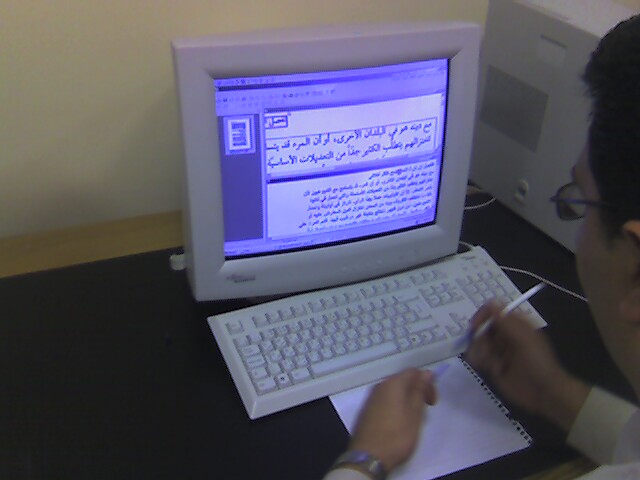
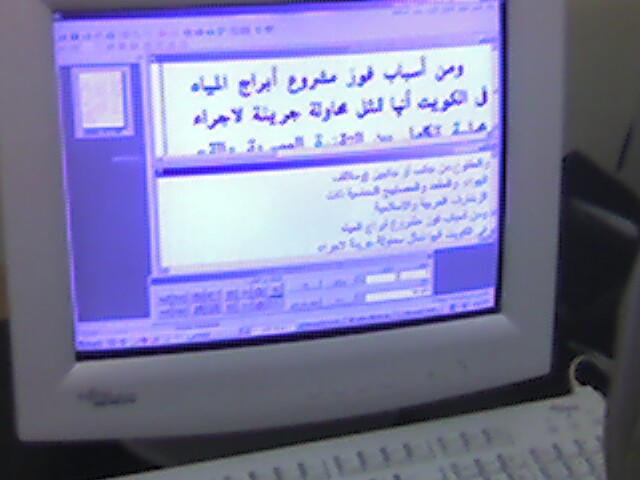
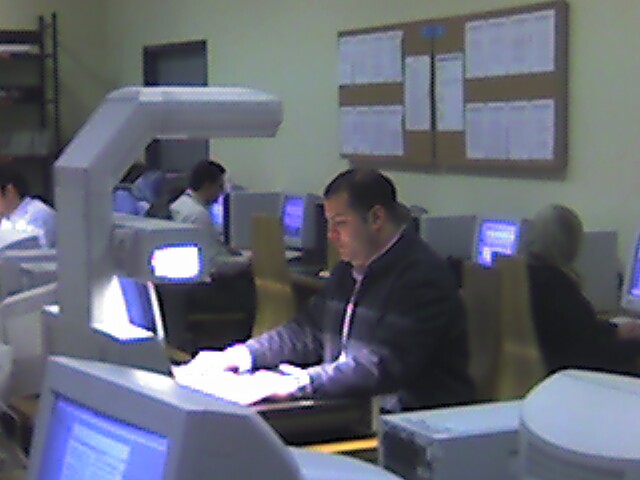
    Bibliotheca Alexandrina digization of Arabic text: 15 January 2006
    Detection of specific genes.....across species: humans and primates
    Clustering of  music
    Clustering of  images
    Detection of patterns of bugs in software
    Detection and avoidance of failures in data centers and massive computation devices
    Detection and healing of failures in the network
    Adaptive improvement

    Enabling rapid creation of new tools of collaboration....
    Human collaboration
    Software collaboration
    Enabling new innovation, new services, new software creations
  • arabic
  • ocr correction
  • scanning
  • ocr pattern recognizers
  • A change is occuring now....a synthesis of tools made possible by powerful computing, massive storage, extensive networks

    A rapid development in Statistical Learning Theory, combined with Machine Learning
    Pattern Recognition
    Pattern Classification
    Cataloging  | Meaning  | Topic discovery |

    Similar problems with different names
    Bibliotheca Alexandrina digization of Arabic text
    Detection of specific genes.....across species: humans and primates
    Clustering of similar music
    Clustering of similar images
    Detection of patterns of bugs in software
    Detection and avoidance of failures in data centers and massive computation devices
    Detection and healing of failures in the network
    Enabling rapid creation of new tools of collaboration....
    Human collaboration
    Software collaboration
    Enabling new innovation, new services, new software creations
  • Google, Microsoft, Sun invest 7.5 million in Reliable, Adaptive, Distributed research: UCBerkeley

  • The foundation of our society rests upon our technology:
    Air, water, food, transport, health care, communication
  • We are extending technology at an accelerating rate
  • This changing balance between technology and human beings may result in
    a burst of creativity, or
    an extension of control,
    or both.
  • Technologies of identity:
    400 million Java cards
    1.5 billion cell phones,
    10 billion RFID tags
    100 billion particles of smart dust
  • Technologies of location
    meter and submeter-accurate mobile phone locators
  • Technologies of sensor fusion
  • Technologies of mobility
  • Technologies of pin-point energy creation and cooling
  • Technologies of permanent, perfect storage
  • Technologies of search:
    Google, et al
  • Technologies of collaboration:
    among people, programs and machines
  • Technologies of creation and rearrangement
  • Tomorrow's information technology enables creative rearrangement of all data, new forms of artistic creation, unexpected new interactions of human innovation
  • Network-centric life

Global Changes Shaping the Next Twenty Years

  • Major long term trends

  • World population growth is slowing dramatically. Global fertility rates are half what they were in 1972.
  • Absolute decrease in Italy, France, Japan, Germany, Spain ...and soon, China, Mexico
  • No industrialized nation still produces enough children to sustain its population over time, or to prevent rapid population aging. Japan's population is expected to fall by a third...
  • "The steepest drops in fertility and the most rapid rates of population aging are in the developing world.
    Because Mexican fertility rates have dropped so dramatically, by mid century, Mexico will be a less youthful country than the United States"
    Longman
  • Massive migration to rich countries
  • Aids swath in Africa
    • Decrease in life span by a factor of two
  • Extension of healthy life span in rich countries
  • A five-year-old in a rich country will realize in this decade that she has 110 years of life ahead of her
  • Aging of national populations
  • US, France, Japan, Italy, Spain....and soon, China, Mexico --not AIDS-affected Africa
  • Vanishing retirement and pension funds. US Social Security system assumes that the number of workers paying into the system will increase by 30% ove the next 80 years...
  • Increasing returns to long-term asset owners
  • Changing family structure
  • Single-child policy means no relatives in family business
  • Massive shift in energy use and resource use
  • China uses 1/3 of world steel output; Chinese per capita BTU use climbing
  • Failing electrical power, water, communications structure
  • Massive infrastructure investment:
    water, electricity, food distribution
  • Climate shift
    • Increasing unpredictability
    • Agricultural migration
  • Financial system decentralization
    • Network based liquidity and asset migration
  • Increasing identitification of people and things
    • Vanishing anonymity
    • Joining location data with image and connection
    • Permanent storage of IP traffic, mail, messages
  • Increasing fragility of infrastructure
    • Increasing interdependence
  • Risk management
  • Thorough, continuous threat assessment
  • Anonymity
  • Changing world governance models
  • Cultural diversity: changing global views held by our children
  • Short-term trends
  • Fear of threats
  • Identity3
  • Increasing technological fragility
  • Permanent memory, permanent audit
    • Actions:
    • Strategic conversations
    • Early warning signals
    • Creative destruction
    • Avoid denial

    Technological Changes

    • Long-term changes

    • Global networks linking billions of embedded devices:Computers around us, computers inside us
    • Universal access
    • Precise locational data:
      command and control for all transportation, all shipments, all pipelines
    • Permanent, perfect memory:
      transparency, accountability, decryption and analysis
    • Permanent memory: new cultural preservation and change
    • Extended idea of city, of company, of government: beyond geographic boundaries:
      A global diaspora for our children: extending community, creating universal links
    • Cities extend beyond human memory: cultural memory, family memory, neighborhood memory
    • All objects enter the conversation: objects come alive

      • Connectivity changes technology
      • Network Speed: sustained or burst
        Supercomputing 2004 World Record: 101.13 Gigabits sustained--over 4 000 kilometers, for 20 minutes--
        30 November 2004
      • Network speed and latency:
        250 millisecond delay inhibits emotional connection between humans:
        500 - 1000 kilometers
      • Identity
      • RFID object tagging
      • DNA unique identity
      • Function to location mapping
      • Location
      • Move from 3D to 4D
      • Anonymity
      • Permanent, persistant, perfect storage changes our ideas of center, distribution, and memory:
      • (Tivo = Set-top box) Nation: "You changed my life": NAB Futures Summit, 2003
      • Honeycomb: clustered petabyte storage: SunLabs
      • Latency
      • Fool the distant teleconferencer
      • Metaphors of interfaces, layers, objects
    • Content innovations: Everyone is a television station, a Pixar
      Everyone is a musician-if you hum, you can create ringtones
      Everyone can show what they see
      Anyone can remix, re-edit, re-synchronize the work of others:
      sing with Sinatra or Presley or Piaf
      Millions can create together: symphony of cell phones, dance of remotely sensed devices

    Technological innovation does not mean technological adoption.

    _______
    The Next Five Years:

    • Open Source
    • New forms of content
    • New ways to find content
    • Cheap 50 megapixel cameras, cheap 50 megabit wireless two-way liquid crystal screens
    • Rising level of abstraction: innovation above the IP layer
    • Self-configuring systems
    • Self-configuring hardware
    • Ubiquitous wireless access
    • Storage costs dropping 60% a year
    • Encryption-enabled application and rights management
    • Multi-threaded support: multi-core CPU Chip multi-threading (CMT)
    • Asynchronous clocks
    • New optical interconnect
    • Identity systems: biometric, DNA chip
    • Pin-point cooling
    • Three-dimensional printers

    Basic Quotations

    • Masayoshi Son
      Softbank
      Yahoo BB
      0947 16 October 2003
      "First, we build a completely IP network-- $800 million dollar investment---
      then we go after voice: only $30 million investment, while NTT spent $30 billion.....
      Then we go after video rental stores: only $20 million investment, while 10,000 stores cost $20 billion.....
      Then we go after TV broadcast: $20 million investment, while broadcasters spent $40 billion......
      Then we go after content creation..........
      Then we go after every legacy industry.......
      [Financial services???]
      Telecom companies should go after many industries, so they can survive....
      [Billing.... storage of value..... identity.... authentication... authorization... exchange]
    • Jonathan Schwartz
      Chief Operationg Officer
      Sun Microsystems
      1045 2 June 2004
      Shanghai
    • "Sun will open-source Solaris"
    • Sun, in its new relationship with Microsoft, will make interoperability with Microsoft a very high technical priority.
      Microsoft is making all details of its interfaces open to Sun.. not to anyone else...so that our customers may interoperate with security
    • "Sun will license both the Java Desktop system and the Java Enterprise system to governments at an extremely low per-citizen cost, reduced dramatically for the 125 least-developed countries"
    • "Sun will provide storage on demand, and charge only for what you use"
    • "Sun will provide computing on demand, and charge only for what you use"
      "Sun will provide hardware for developers for free, with a software subscription for three years"
    • "You can download Solaris 10 for free, today, and try the new container technology and the incredibly powerful Dynamic Tracing capability available nowhere else"
    • "Sun is changing its business model to fit a new age of partnership and cooperation: long-term commitment through subscription, permanent choice enabled by a new relationship"
    • Sun, with its new relationship with Fujitsu, now has the broadest product range of any...I mean any....information technology company"
    • Marcel Proust
      1896
      The voyage of discovery is not in seeking new landscapes but in having new eyes.
      We do not receive wisdom, we must discover it for ourselves, after a journey through the wilderness which no one else can make for us, which no one can spare us, for our wisdom is the point of view from which we come at last to regard the world.
    • Bill Joy
      Chief Scientist, Sun
      1992
      First law of technology: there will be innovation.
      Second law of technology: it will occur somewhere else.
  • Scott McNealy
    Chairman
    Sun Microsystems
    The World
    1519 27 July 2004
    Dana Point
    We are building systems that run the world's biggest governments.
    ....China has the most complex networking and computing challenge in government....

    Nobody can compete with us on margins on Intel-compatible systems....
    People don't think of us as low-cost providers...but just stay tuned..
  • David Brin Transparent Society
    New York, 2001
  • There are two kinds of cities:
  • Those with cameras everywhere, where the images go to the police
  • Those with cameras everywhere, where the images go to the citizens.
  • There are no other kinds of cities
  • Vladimir Matukhim
    Deputy Minister
    Ministry of Communications
    Russia
    0950 22 June 2004
    Moscow
    We can start now in building common infrastructure for security. We must build a secure international information system, in order to bring world resources together to combat terrorism, and to build a secure world for commerce and economic development.
    Sun Microsystems is known for its powerful systems that run the most important applications in governments world-wide, and, together with Sun, we expect to build the foundations of secure computing for Russia. .
    aided by Vladimir Marilovtsev , Director, Foreign Projects, Swemel
  • This new freedom of choice threatens the forces of control
    "Copyright and intellectual property extremists threaten to put children in jail, or to extract fines and penalties, inhibiting creativity where it matters most."
    Professor Larry Lessig
    Stanford Law School
    China and the Internet Conference, UC Berkeley,
    1 May 2004
    www.lessig.org
  • Orville Schell
    Dean of Journalism, UC Berkeley 30 April 2004
    China is, itself, a contradiction. It exists in two halves-- economic:where peoples's energies can be exercized, and political: slow-moving, less conscious attempt to change.
    The Internet is coming into interaction with a society that is half in dynamic state, and half in quiescent state.

    Will China change the Internet, carve out the piece it finds utilitarian and control the rest? Can it?
  • Masayoshi Son
    0935 16 October 2003
    Broadband penetration
    In 2003,
    Broadband ranking:
    USA: 25 million
    Japan: 12 million
    Korea: 12 million
    but
    Broadband greater than 1 Megabit:
    Japan: 10 million
    Korea: 8 million
    USA: 6 million
    Norway: 3 million

    Provocative Reading:

    • Stephen M. Walt
      Taming American Power:
      The Global Response to U.S. Primacy
      W.W. Norton, 2005
    • Phillip Longman:
      The Empty Cradle
      How Falling Birthrates Threaten World Prosperity

      Basic Books, New York, 2004
    • The 9/11 Commission Report
      Final Report of the National Commission on Terrorist Attacks Upon the United States
      W.W.Norton, New York, 2004 www.rmi.org/sitepages/pid626.php
    • Creating a Trusted Information Network for Homeland Security
      Second Report of the Markle Task Force on National Security
      Markle Foundation New York, December, 2003 http://www.markle.org/markle_programs
    • Lawrence Lessig
      Free Culture :
      How Big Media Uses Technology and the Law to Lock Down Culture and Control Creativity

      348 pages | ISBN 1594200068 | 25 Mar 2004 | The Penguin Press
    • Douglas Englebart:
      Augmenting Human Intelligence 1963
    • J.C.R. Licklider:
      Man-Machine Symbiosis, 1960
    • Rocky Mountain Institite:
      Design Recommendations for High-Performance Data Centers, 2003 www.rmi.org/sitepages/pid626.php
    • The Blocker Tag: Selective Blocking of RFID Tags for Consumer Privacy by Ari Juels, Ronald L. Rivest, and Michael Szydlo May 16, 2003. (Submitted.)
    • Jane Jacobs
      Dark Age Ahead
      Random House, 2004
    • Jacques Attali:
      L'homme nomade,
      Fayard, 2003
    • Richard Feynman:
      The Pleasure of Finding Things Out: Chap 2:
      Computing Machines of the Future

      1985 Nishima Memorial Lecture
      There's Plenty of Room at the Bottom
    • Silvio Micali and Ronald L. Rivest
      Proceedings of the Cryptographer's Track at the RSA Conference 2002, Bart Preneel (ed.), Springer Verlag CT-RSA 2002, LNCS 2271, pages 149--163.
    • KevinLynch:
      Image of the City, 1960
      City Sense and City Design, 1990
      A Theory of Good City Form, 1981
      • George Lakoff:
        Women, Fire, and Dangerous Things, 1985
        Moral Politics, 1995
        Where Mathematics Comes From, 2000
      • Gilles Fauconnier:
        Mappings in Thought and Language, 1997
      • Christopher Alexander:
        Pattern Language: Oxford, 1977
      • Christopher Alexander:
        The Nature of Order: The Phenomenon of Life; Center for Environmental Structure, 2003 www.patternlanguage.com
      • Stephen Wolfram:
        A New Kind of Science, 2003.
      • National Academy of Sciences,USA:
        Embedded Everywhere

        NAS, 2003.
      • Andrew Odlyzko
        The Case Against Micropaymentshttp://www.dtc.umn.edu/odlyzko
    • New technologies are changing the relationship between human beings, objects in the world, and human understanding
    • New technologies are changing the relationship between countries and human organizations