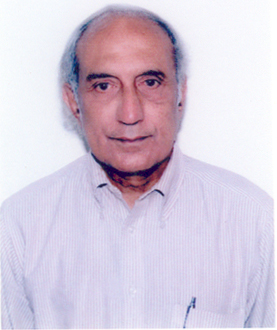
Krishnan, Varadachari
Professor V. Krishnan, Hindustan Lever Research Professor at Jawaharlal Nehru Centre for Advanced Scientific Research (A Deemed University), Bangalore, India, is associated with Educational Technology Unit of the Centre. He had his early education at Madras University and Banaras Hindu University, and obtained his doctorate degree in Chemistry from Indian Institute of Science, Bangalore. He carried out his postdoctoral work at the H.C. Orsted Institute of, University of Copenhagen, Denmark and Texas A&M University, USA. He joined as a faculty at the Indian Institute of Technology in Bombay and later transferred to the Indian Institute of Science at the Department of Inorganic and Physical Chemistry. He established an internationally known Bioinorganic School. The main research interest of Professor Krishnan is in the area of photochemical conversion of solar energy using bioinorganic models. His research contributions cover wide areas in Chemistry, Molecular Spectroscopy, Macrocyclic Systems, Electrochemistry and others. He has over 200 research publications in journals of international repute. His research contributions have been widely recognized both nationally and internationally and continue to contribute significantly to research.
Professor Krishnan has been the recipient of many awards and honors. He is a Fellow of the Indian Academy of Sciences, Indian National Science Academy, Fellow of the Third World Academy of Sciences. He was UGC National Lecturer, Khundkar Memorial Lecturer (Dacca), Visiting Professor at Argonne National Laboratory, Illinois, USA, University of Houston, Texas, USA, University of Dundee, Scotland, University of Wageningen, The Netherlands, ETH, Lausanne at Switzerland, University of Strasbourg, France and others.
Professor Krishnan is immediate former President of the Jawaharlal Nehru Centre for Advanced Scientific Research, Bangalore. Many important positions as Chairman/Membership of Advisory Committees of many agencies and departments: University Grants Commission, Department of Science and Technology, Council of Scientific and Industrial Research and Department of Atomic Energy have been held by him. He was the Secretary, Indian Academy of Sciences (1989–94) and Vice-President (Science and Society) of Indian National Science Academy (2000–02).
Professor Krishnan has an abiding interest in science education. He has been a great teacher and deeply involved in science education. He has been an author in NCERT High School Science Textbooks and also School Science Textbook (earlier version) for Karnataka Government. His commitment to science education is great and he has been involved in the promotion of Science Education in many countries.