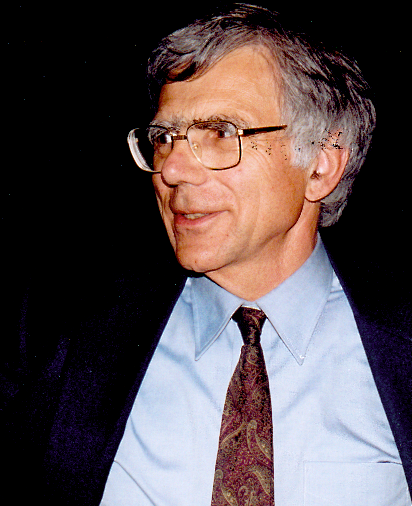
Léna, Pierre
Pierre Léna is a Member of the French Académie des sciences (since 1991), of the Academia Europeae (1992) and of the Pontifical Academy of Sciences (since 2000), Corresponding Member of the Société Royale des Sciences de Liège (2002). He is Chevalier de la Légion d’honneur and Officier de l’ordre du Mérite.
Since 1993, he is Professeur de physique et d’astrophysique at the Université Paris 7 – Denis Diderot.
The scientific work of Pierre Léna has been centered on the development of infrared astronomy, a new branch of astronomy born ca. 1960 and today a major one.
He adapted to the infrared domain high resolution imaging techniques (speckle interferometry) discovered by the French astronomer Antoine Labeyrie, with his students, he was the first to apply them to the study of star formation, showing the evidence of dust cocoons around forming stars and measuring their size. This work led him in 1980–1990 to propose and to establish the possibility for the European Very Large Telescope, since 1998 operative in Chile, to operate as an optical interferometer, again following ideas put forward by Labeyrie. The VLT Interferometer is now ready for operation and is the most powerful instrument of its kind in the world, while scientific programs are established, especially for the observation of extra-solar planets. Since 2000, he fosters a new interferometer entirely based on optical fibers and connecting large telescopes on the summit of Mauna Kea (Hawaii).
Along with this work, he led a team to implement on an astronomical telescope a novel technique called adaptive optics, which aims to suppress the deleterious effect of the Earth atmosphere on astronomical images: after initial success in 1989, adaptive optics is now adopted worldwide on modern giant telescopes. With his students, he applied it to many astronomical objects, such as comets, planets, interstellar medium, active nuclei of galaxies, etc.
He has directed the Graduate School for Astrophysics in University Paris 7 from 1976 to 1984, then again 1992–1996 when he became Director of the Unified Graduate School of Astronomy for Ile-de-France Universities and Observatoire de Paris, until 2002.
He was President of the Société française de Physique, 1989.
His interest for educational matters led him to become President of l’Institut national de recherche pédagogique, 1991–1997.
This led him, with Georges Charpak and Yves Quéré under the auspices of the French Académie des sciences, to become active in the renovation of science teaching in primary schools (La main à la pâte), first in France since 1996, then in many countries, as discussed at a number of international conferences and later implemented.