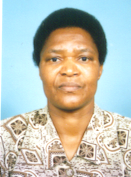
Lenga, Florence K.
A Soil Scientist by profession, specialized in Soil Physics and Agrometeorology, a social, friendly and self-motivated, responsible person with leadership skills, having begun her career as an agricultural graduate in 1977. She started her career as a researcher in the area of agrometeorology with the then Kenya Agricultural Research Institute (KARI)–Muguga during the transition period of the EAFRO in late 1970s, and later with the larger KARI of today. Her career as a trainer started early in life: as an uncertified teacher in primary and later in secondary schools, moving on to a demonstrator at the University level, part-time lecturer, and lastly culminating to the level she is today.
During her training and work experience she noted the low representation of girls in science-oriented careers. For example, in the College of Agriculture and Veterinary Medicine at the University of Nairobi, during her years of training, the percentage of girls was about 20% at the Faculty of Agriculture and 6% at the Faculty of Veterinary Medicine. At the research institute workplace the percentage of women researchers was a mere 3%.
Having noted the low representation of women in the science field, she felt challenged to take the lead to sensitize girls in high schools to take science subjects seriously under the new 8–4–4 system of education which provided equal opportunity to both men and women to opt for science-oriented careers. This was under the support of the then Jomo Kenyatta University College of Agriculture and Technology (JKUCAT) administration in July 1991. It was then that she led a team of staff members to organize the first seminar on women in Science and Technology for secondary school girls, mainly for forms three and four students.
The 1991 seminar was sponsored by JKUCAT. In 1992, she personally wrote a proposal stating the success and need for follow-up of the 1991 seminar to a wider spectrum of girls in Kenya. The proposal was accepted by the British Council, who granted her two-hundred-thousand Kenya shillings (Kshs.200,000) to conduct a series of seminars to high school girls at selected venues, namely: Embu, Mombasa and Nairobi. The proceedings of the 1991 and 1992 seminars were circulated to District Education Offices and participating schools.
The impact of the above seminars was a marginal increase in the number of girls admitted into the BSc programs offered at JKUAT and elsewhere. Though the trend has not been continuously upward (rather fluctuating with time), there has been more awareness by girls on the greater opportunities available for them at tertiary level as regards to science-oriented programs.
Her greatest contribution to girls’ education was from 1998 to 2001, when she was offered the challenging task of coordinating the Female Education in Mathematics and Science in Africa (FEMSA) project in Kenya, with the main objective of increasing the participation and performance of girls in Science, Mathematics and Technology subjects (SMT). It was during this time that the constraints leading to low participation and performance of girls in SMT subjects in the Kenyan context were researched upon and documented. Means of eliminating or minimizing the constraints were explored and a selected number were practically constituted and tested in thirteen pilot schools ranging between primary and secondary levels. By the end of the project the pilot schools and the surrounding community had established measures that were in use and had achieved remarkable success as exemplified by the:
· Setting of Resource Centers at school level for use in the teaching of SMT subjects.
· Practical approach of teaching SMT subjects in general and especially in SMT subjects.
· Improved results in SMT subjects, especially girls, at the school and zonal levels, and national examinations.
· Demand of published FEMSA Kenya materials even after the termination of the project.
· Demand by other schools to be incorporated into the FEMSA Project towards the end of the project.
· Increased demand for her to give talks to girls in schools to motivate them to taking learning seriously, and especially in the area of science and mathematics.
Stakeholders and partners in the project, such as Female Education in Mathematics and Science—Kenya Chapter (FAWEK), Ministry of Education Science and Technology (MOEST), Kenya Institute of Education (KIE), and Kenya National Examination Council (KNEC), having taken some of the recommendations further and enacted on them in promoting the girl–child education in Kenya.
She thus feels enthusiastic in having been associated, and in the forefront, with other stakeholders in the promotion of the girl–child education in the areas of science, mathematics and technology subjects, in Kenya and abroad.