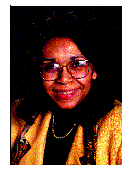
Malcom, Shirley M.
Shirley Malcom is Head of the Directorate for Education and Human Resources Programs of the American Association for the Advancement of Science (AAAS). The Directorate includes AAAS programs in education, activities for underrepresented groups, and public understanding of science and technology. Dr. Malcom was head of the AAAS Office of Opportunities in Science from 1979 to 1989. Between 1977 and 1979, she served as program officer in the Science Education Directorate of the National Science Foundation (NSF). Prior to this, she held the rank of Assistant Professor of Biology, University of North Carolina, Wilmington. Other work experience includes two years as a high school science teacher.
Dr. Malcom received her Doctorate in Ecology from the Pennsylvania State University; Master’s degree in Zoology from the University of California, Los Angeles; and Bachelor’s degree with distinction in Zoology from the University of Washington. In addition she holds eleven honorary degrees.
Dr. Malcom serves on several boards, including American Museum of Natural History, Howard Heinz Endowment, and National Center on Education and the Economy. She serves as a trustee of Adelphi University, as a Regent of Morgan State University and as a trustee of Caltech. In addition she has chaired a number of national committees addressing education reform and access to scientific and technical education, careers and literacy. Dr. Malcom is also a former trustee of the Carnegie Corporation of New York. She is a fellow of the AAAS and the American Academy of Arts and Sciences.
Dr. Malcom is a member of the National Park System Advisory Science Board. She served on the National Science Board, the policy-making body of the National Science Foundation, from 1994 to 1998 and from 1994–2001 served on the President’s Committee of Advisors on Science and Technology.