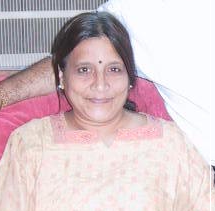
Mehta, Jayshree A.
Profession: Scientist/Educator
Position: Director, SATWAC Foundation (Science and Technology for Women and Children Foundation) Ahmedabad, India
International position
Chair, Gender and Science and Technology (GASAT) International Association (1996–2001)
President, Once and Future Action Network (OFAN) (1998–2001)
Chair, International Organization for Science and Technology Education (IOSTE) (1996–1999)
Steering Committee Member of UNESCO Project 2000+, Paris
Member of the Consultative Group of FEMSA (Female Education in Mathematics and Science in Africa) run by FAWE in 12 African countries, (1998–2001)
Keynote speaker in number of international conferences
National position
Chairperson, Ladies Wing, Gujarat Chamber of Commerce and Industries (GCCI) (2000–2001)
Member of the Advisory Group on Curriculum Reforms
Trustee and Advisor to Entrepreneurship Development Organizations, Women’s organizations and Schools
Merit and Scholarships
1. Awarded merit scholarship of Government of India in Secondary School Certificate Examination (1966)
2. Recipient of American Field Service scholarship for senior year high school graduation. Tower Hill School, Wilmington, Delaware, USA (1967/68)
3. Awarded three gold medals by Gujarat University for the top ranking at Masters level MSc (1973). The first woman in Gujarat University to receive this honor.
4. Awarded British Council scholarship (1984) for studies in UK.
5. Awarded Membership of the National Research Council, USA.
Educational qualifications
Secondary School Certificate Examination (SSCE) (1967) C.N.Vidyalya, Ahmedabad, India
High school graduation (1968), Tower Hill School Wilmington Delaware, USA
BS (Distinction), St. Xavier’s College, Ahmedabad, India, with Physics and Mathematics major (1971)
MS (Distinction) with Electronics and Radio Physics (1973) Gujarat University
Doctoral Research in Infrared Astronomy at Gujarat University, Ahmedabad (1973–76).
Certificates
Course at Lawrence Hall of Science, University of California at Berkley, USA on Science Education (1977)
Certificate course on Science, Technology and Society (STS) at the University of Bradford, UK organized by the British Council. (1984)
Course on Science Video scripting and production at Space Application Center, Ahmedabad (1986).
Research experience
1. Research, development and innovation work on Science Education and Science Popularization (Public Understanding of Science). Published number of articles in several International Journals on Science and Technology Education.
2. Leader of several research and development projects in Science and Mathematics Education at formal and non-formal level.
3. Research work on Gender, Science and Technology at National, Regional and International level.
4. Initiated and lead research project on SAS (Science And Scientists) carried out by 22 researchers in 15 countries.
5. Coordinated research project on Sexual Maturation of School girls and Practice of Menstrual Hygiene carried out in 9 countries of Africa and Asia.
International experience
Participated in several International conferences and workshops in Europe, America, Australia and Asia. Presented papers, conducted workshops and invited to deliver keynote addresses.
1. Chairperson of International Gender and Science and Technology Association (GASAT). Organized International GASAT 8 Conference in India in January 1996 in which 250 delegates from 44 countries participated.
2. Chairperson of International organization of science and Tech. Ed. (IOSTE) 1996–99. Chaired Science Education group in IOSTE conference at Kiel, Germany, in 1987.
3. Chairperson of focus group on Nonformal and Informal Science education of UNESCO project 2000+.
4. Deputy-Chair of UN Expert Group on Education for Preparation of Platform for Action, Beijing document.
5. President of International Organization—Once and Future Action Network (OFAN).