Text Box:

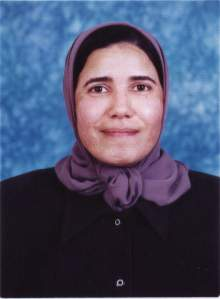
Mohran, Zaynab

Born in January 1957 at Sayeda Zaynab district, Cairo, Egypt.

–       Received elementary school education in Zinhoum elementary school, preparatory education in Amin Samy School, secondary education in El-Saniya Secondary School and graduated in 1975.

–       In 1975, joined the Faculty of Science, Cairo University, completed two years of education and quit the Faculty in 1979, prior to finalizing the BSc study, to go to the United States of America.

–       1979–1981, joined the Graduate School USDA (Washington DC) and took courses in English and mathematics.

-     1981–1985, joined Howard University (Washington DC) and earned a BSc in Chemistry with grade point average of 3.67 and Maga Cum Laude Honor. From 1982 to 1985, was awarded yearly scholarships.

-        1985–1986, joined the graduate program of the Chemistry Department, Maryland University (College Park) as a graduate student and was awarded a Teaching Assistantship.

-        1986–1991, joined the graduate program of the Biochemistry Department in the Medical School of the Georgetown University (Washington DC), was awarded a Research Fellowship and earned the PhD in biochemistry and molecular biology (The Cloning and Characterization of a Thyroid Hormone Receptor cDNA from Xenopus lavies).

-        1991–to date, has been working as a Medical Research Scientist at the US Naval Medical Research Unit No. 3, Cairo, Egypt.

-        Have translated and written several works focusing on simplifying sciences to youth.

-        Member in the Science Literacy Committee of the Supreme Council of Culture, Cairo, Egypt.

-        Member in the Egyptian Union of Writers, Cairo, Egypt.

-        Member in the Sciences and Technology Committee of the Library of Alexandria, Alexandria, Egypt.


IMPROVING SCIENCE EDUCATION FOR YOUTH AND CHILDREN

Achieving science literacy in a society is an intricate and long process, but certainly it begins during childhood. In order to begin this long journey for preparing a science literate society, it has become essential to exert great efforts in developing the current applied approaches in science education. Developing the current approaches is a very important process that is a prerequisite for preparing future generations qualified to meet the demands of the modern scientific and technological advances. It is evident that such a process requires the sincere efforts and cooperation of science specialists and educators in preparing a comprehensive strategy for developing science education and improving science literacy, starting during childhood. This work focuses on some of the suggestions, which are perceived as important steps in developing science education in our country. The first suggestion calls for working on establishing new science education standards that emphasize excellence and equity and offer all students the opportunity to learn and understand science. The second calls for taking the necessary steps to prepare skilled professional science teachers, since they are the medium, who deliver science to children. The third focuses on the behavior and responsibilities of the science teacher, which affect his performance and efficiency. The fourth calls for reducing the quantity of science curricula and focusing on the major unifying themes on which science is based. The fifth calls for transforming the classroom into a laboratory and giving more weight to scientific explorations and activities to help children understand science. The sixth focuses on the importance of the family role and home activities in developing and shaping the child curiosity and observation, traits essential for understanding and enjoying science. The seventh deals with the importance of assigning a scientist notebook to each child, starting from kindergarten, and teaching him to write down all interesting observations he sees around him, imitating scientists. Finally, the eighth suggestion calls for a sincere cooperation and establishing team work among all parties involved in the science education system: the Ministry of Education, the media, the family, and other nongovernmental organizations. All of these suggestions will be discussed in more details.