Text Box:

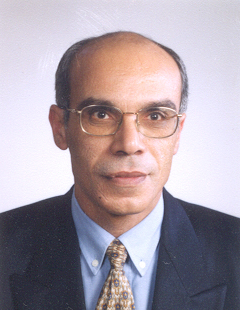
Nouh, Mohamed Mosaad

Mohamed Mosaad Nouh is a Professor of Curricula and Mathematics Education, Department of Curriculum and Instruction, and Vice-Dean for Postgraduate and Researches, Faculty of Education, Alexandria University.

Scholar of Faculty of Education, Alexandria University. He obtained his Baccalaureate (Mathematics), Special Diploma, Master and Philosophy Doctorate of Education (Curricula and Mathematics Education). In the primary field, he conducted teaching, studies and methods of researches in curricula and mathematics education, specially: mathematics curriculum development and students understanding of mathematics.

Currently, his interests are in mathematics curriculum development/ assessment according to national/international standards, mathematical literacy, mathematical knowledge (theory and context), mathematical reasoning models (algebraic, geometric, intuitive) for children. He published more than 25 papers, nationally and internationally. He attended and presented his researches in numerous national conferences and meetings/international conferences are at the University of the United Arab Emirates, Kuwait University, Tunis (Arab Development Institute), Canada (Lakehead University). Crete (University of Crete) and Syrian Arab Republic (Higher Education Ministry). He is Membership and Authors of Educational Societies and Institutes journals, nationally and internationally.


MATHEMATICAL LITERACY: VIEWS, STANDARDS AND CONTEXT

Mathematics is a real story. It’s the story of thought, communication and science.

Mathematics is a language of the language, knowledge of the knowledge, it’s a civilization in the all civilizations; the numbers, geometry, functions and graphs, the probability, spaces, problem-solving, paradoxes, puzzles and patterns, and postulates and rigors…are the actual stories in civilizations. Mathematics is a story of nation.

When the peoples reflect and understand it; intuitively and logically, the structures and language of mathematics becomes conceptual bridges for communications, literacy and reasoning.

In history of mathematics, mathematics knows multi-civilizations and it was the human bridge for communications. Mathematics discovered/ invented has multi-styles and it shifts from a conceptive system to another: depended–free, contextually–non-contextually, practice–platonic, intuitive–logically, Euclidian–non-Euclidian, classification–non-classification.

Now, the humanistic mathematics is a principle issue in learning, knowledge and education. Mathematics is a language of understanding, reasoning, and communication. It helps us to modeling our environment/ society and science.

Mathematical literacy is a power and value of the society. In the recent development and new reforms, the mathematically literacy is a center and standard in mathematic education. The goal is to developing of mathematical literacy at children and students at all stages.

The basic conceptions and views are: (1) change our views and beliefs about how a child thinks; (2) change our conception about mathematics and mathematical knowledge.

Mathematical literacy

Mathematical literacy is additional achievement of the algorithms, skills and formal methods. Mathematical literacy is a field of “Mathematics Sense-Doing” that is based on mathematical language, mathematical understanding, mathematical communication, understanding the contemporary relationship between mathematics and society and technology. It is to find a great place for mathematics in one’s sense-natural functions. Mathematical literacy must include the ability to:

  1. Understanding of mathematics importance and assessment of its value and history.
  2. Understanding of mathematics as a language of patterns, reasoning and science.
  3. Developing of awareness that mathematics helps us to modeling the environment.
  4. Developing of awareness of the relation-ship between mathematics and natural/society/cultural society.
  5. Understanding of relationship between mathematics and technology.

In a diagrammatic–framework, the paper provides ten dimensions of mathematical literacy as:

  1. Number Literacy
  2. Geometry Literacy
  3. Algebraic Literacy
  4. Statistical Literacy
  5. Mathematical Reasoning Literacy
  6. History of Mathematics Literacy
  7. Computer–Mathematics Literacy
  8. Societal Mathematical Literacy
  9. Moral Mathematical literacy
  10. Math–Measurement and Estimation literacy.

The paper provides these fields according to (1) High standards, and (2) Specific standards and the relationship between the content and context.