|
|
Biography |
|
|
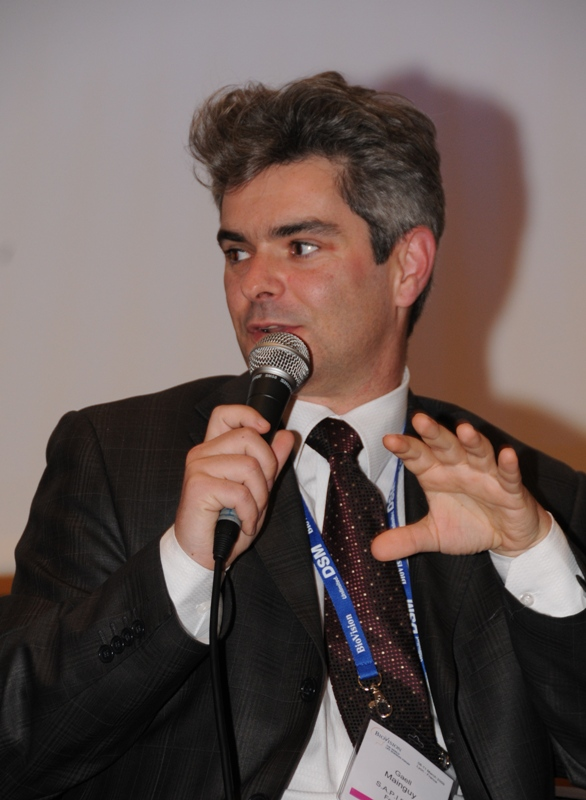 Gaëll Mainguy is a former pupil of the Ecole Normale Supérieure in Paris and a Doctor in Molecular biology (Pierre and Marie Curie University). He successively works for the CNRS (Paris), the Center for Biomedical Genetics (Utrecht, The Netherlands) and the INSERM (Paris). Since 2004, he is the head of the World Association of Young Scientists (WAYS), a network of networks founded by UNESCO that connects young scientists across the world, irrespective of their discipline, and creates areas for interactions between science and society. Gaëll Mainguy joins the Veolia Environnment Institute in 2006 to develop the scientific editorial policy. In 2008, he founds S.A.P.I.EN.S, a general, peer-reviewed, open access, multidisciplinary journal focused on integrating knowledge for sustainability. He is currently the editorial director of S.A.P.I.EN.S.
|
|
|
|
|
|
|
Abstract |
|
|
|
|
|
|
|
|
Structuring information into knowledge is an important challenge for the 21st century. Scientists are seeking efficient ways to access relevant information, be creative, get recognition and diffuse their work. The power of internet and the diffusion of collaborative practices provide new tools to build and share knowledge. In principle, the internet has the capacity:
to collect and store all knowledge,
to make it instantly accessible by anyone and anywhere, to convey discussions and present debates
Beyond knowledge sharing, the internet could also change the process and scale of creative collaboration itself, a change enabled by social software such as wikis, online forums, and their descendants. But today science practices are still largely immune to these approaches.
This lecture will explore how open access practices and collaborative endeavors are profoundly modifying access to knowledge and how they may provide suitable conditions for a reorganization of the academic landscape.
|
|
|
|
|